011-015 喂,係邊個啊?
How do we express identity? This block of lessons introduces how to say “I am,” “you are,” and so on, asks Who questions, answer the phone, and express unhappy surprises.
The “focus crystal” of this bloc of lessons is a short phone conversation. The capstone challenge is for the Learner to
- write a five-line phone conversation, and
- perform for a public
Lessons
Section titled “Lessons”001 - The Cantonese Sound
Section titled “001 - The Cantonese Sound”Resources
Section titled “Resources”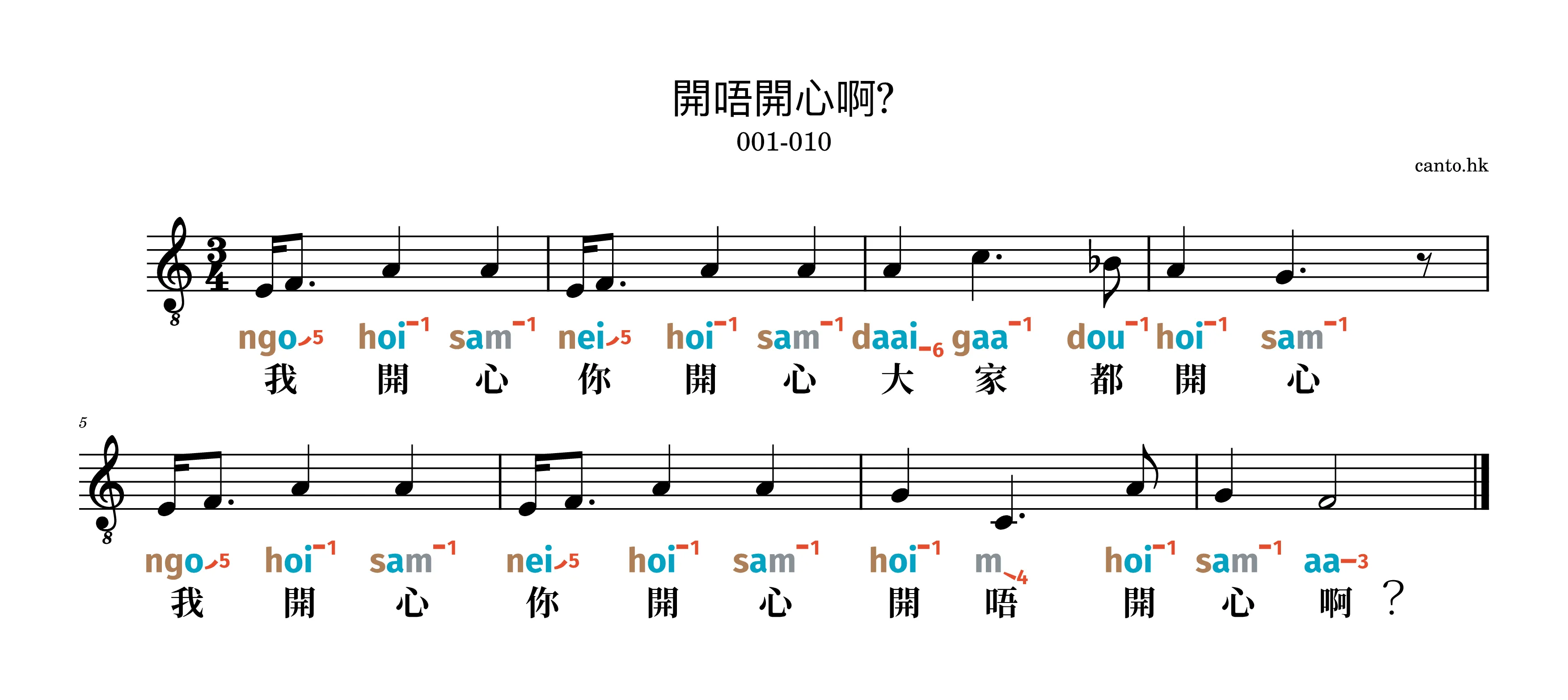
Outline
Section titled “Outline”- Sing the melody with solfege. Introduce one bar at a time;
Teachersings, thenLearneremulate. Repeat several times until confident. - Sing the melody with Jyutping. One bar at a time, making sure the top line is ready before moving on.
- Distinguish character 字 and word 詞, and introduce the components of Jyutping.
- List and give examples of initials and finals, noting the exceptions
- Practice pronouncing single words, then sentences 今朝家姐開開心心返工、哥哥(唔)花心
- Distinguish
-amand-aam - Spot check using cheatsheet list of finals
- Practice transcribing audio. Do one row at a time, giving feedback before moving on. Finish characters before moving onto words.
- a cue for the Cantonese sound is “hammer” or “piano-like”, as opposed to “sliding” or “violin-like”. Each syllable is one sharp, short, distinct sound; there is no equivalent sound to miasma or Mandarin xian. This cue is useful to introduce before diphthongs like
-aaior-ei. - I’ve built a Jyutping Singer tool that generates, in real time, both sheets and music for what a sequence of Jyutping should sound like
002 - Practice (add j-)
Section titled “002 - Practice (add j-)”Today we repeat the practice exercises from the lesson, and additionally introduce the initial j-. Teacher will need to provide explicit instruction. Here are some suggested characters and words that matches what the Learner should be able to do, but feel free to introduce others.
Sing the tune again; substitute 返工 for 開心.
003 - The Sentence Primitive
Section titled “003 - The Sentence Primitive”Similarities between Cantonese and English:
- same SVO (subject-verb-object) structure
- no noun declension
- no noun genders
Cantonese is different from English:
- has no plural form (boy / boys, woman / women)
- has no conjugation (eat / ate / eaten)
- verbs and adjectives are often interchangeable (你好靚 / 靚咗喎)
- in general, parts-of-speech maps noisily. For simplicity, in this course we will pretend it does.
The difference in the written script is more pronounced:
- the Chinese script do not use white-space to delimit words.
- this is an issue for learners, since they implicitly need to perform word segmentation. This is a difficult problem.
- in this course, we will use underlining or white-space (我哋 食咗 飯 喇) to ease the learning
- a character 字 is a single “square drawing”. Characters regularly map to a variety of readings and meanings, and sometimes can be written in different ways (alternative orthography 異體字).
- a word 詞 is formed from one or multiple characters (e.g., 睇, 徘徊). These usually have only one reading and one meaning.
- text found in the wild is most likely written in Standard Written Chinese, and do not correspond to how it would be spoken. Standard Written Chinese differs from (written/spoken) Cantonese in both vocabulary and grammar.
- for most of this course we will minimize confusion and only have text that is in Written Cantonese
Encourage code-mixing; this vastly expands what the Learner can express.
004 - Practice (add toothy z-)
Section titled “004 - Practice (add toothy z-)”Today we repeat the practice exercises from the lesson, and additionally introduce the initial z- but only as the hard /ts/. That is, we include characters 精 職 踭 but exclude 做 將 左. (Include nuclei -a, -aa, -e, -i, but exclude -o, -eo, or -yu)
Teacher will need to provide explicit instruction. Here are some suggested characters and words that matches what the Learner should be able to do, but feel free to introduce others.
Sing the tune again; substitute two other terms for 開心. Explain the meaning of the resulting song.
005 - Question Formation with A-唔-A
Section titled “005 - Question Formation with A-唔-A”A-唔-A (A-not-A) is one of the two basic question formation method that does not use special question words like 「點解」「邊度」. (The other is attaching 呀? )
- 🚫 A-唔-A cannot be used for to have 有 (有唔有🚫).「唔有」 as a fragment is substituted by 冇 . (Point out the writing of 有-冇, and for fun, existence of 𠕇 which doesn’t mean what you might think it means.)
- ✅ A-唔-A can be used for most other verbs and adjectives:
- verb: 係 -> 係唔係
- adj: 好 -> 好唔好
- multi-character words applies this rule by isolating the first syllable. Examples:
- 開心 -> 開唔開心
- handsome -> han-唔-handsome
- comfortable -> com-唔-comfortable
006 - Practice (typing Jyutping)
Section titled “006 - Practice (typing Jyutping)”So far the practices have been (1) transcription and (2) pronunciation. Add in simple respond by typing Jyutping. This becomes preparation for 007.
Add in listening to, while having access to the Jyutping-annotated script (ideally with translation). Teacher reading this can adjust the speed as needed, provide clarifications, and Learner can choose to repeat on a sentence- or paragraph-level as an articulation exercise. Make this 5-10 minutes every day.
007 - Typing Chinese on Desktop
Section titled “007 - Typing Chinese on Desktop”Today we’ll get setup and type Chinese script using Jyutping. This is quite simple, but a most impressive feat to native speakers. We will also use the Cantonese Font to show Jyutping on the Chinese characters.
We will defer the mobile platform to a later day.
- Install the TypeDuck keyboard input method.
- Install any of the Cantonese Font variants.
Learnershould use the Large Jyutping 大粵拼, whereasTeacherwill benefit from installing every variant in one series (Regular, Bold, No Jyutping, and Large Jyutping). - Learn to type words inside a word processor without typing the tones. Mac/Keynote or Mac/Pages is the first choice, but Mac/Word or Win11/Word can also be acceptable. Guide the typing of 你開唔開心啊, then practice with 我花心
- Use the Cantonese Font to display the Jyutping over the Chinese characters.
- Use
sikto show how one can use the English hint to help select 色 (color) - (bonus) use
v,x,w, andvv,xx,wwto pinpoint a tone - (bonus) use
hsto show the possibility of typing with just initials - Type Chinese style punctuations: , 、 。 ? ! 「 」
On TypeDuck:
- on Windows you will need to handle some security pop-ups. TypeDuck’s source code is publicly available, and it was developed by an Education University team headed by Prof Lau Chaak Ming 劉擇明, who is also the current chair of the Lingustic Society of Hong Kong and developed the Cantonese dictionary 粵典 and 冚唪唥 graded readers.
- can be configured to show only English hints
- provides some gentle tolerance for imperfect Jyutping. For example, typing
yutpingwill still return 粵拼 as an option. - the rankings are adaptive; frequently used words shows up higher
On Cantonese Font:
- Chinese-to-Jyutping conversion procedures usually have a 8-20% error rate. v2 of the Cantonese Font (included in Pass) has about 1.5% error rate, and the private v3 further improves this to 0.2–0.8%.
- the Font formats regular Jyutping-like strings to attach tone-marks for them
- the
VF Cantonese - Support - Only Jyutpingvariant shows only Jyutping without the Chinese characters - the Font includes a variety of other functions; see the second page in the 001 cheatsheet
- use
~or.jyutpingto override pronunciations manually
- use
- when both Regular and No Jyutping variants are installed, you can use
cmd-Ito toggle Jyutping on and off. - your course designer also invented the Font 😎
008 - Practice (add typing Chinese)
Section titled “008 - Practice (add typing Chinese)”We now have a full repertoire of practice exercises:
- Transcription (speech -> Jyutping)
- Pronunciation (Jyutping -> speech)
- Pronunciation (Chinese -[Jyutping]-> speech)
- Zh-En Translation (Chinese -[Jyutping]-> English)
- oral Q&A
- written Q&A. Use the same frame as in the oral Q&A task.
- In a new file, prepare a list of the vocabulary learnt, separated by the diffenrent parts-of-speech
I suggest Teachers scaling the difficulty so that 90% of attempts require some time to think, recall, or look-up but is ultimately successful. For most Teacher this blend will feel “too easy” but it’s probably already cognitively taxing for the Learner. Native speakers tend to vastly underestimate the difficulty of a task.
009 - Vocabulary Expansion
Section titled “009 - Vocabulary Expansion”We add the following vocabulary:
- pronouns: 佢 、 哋
- adjectives: 灰心 、 真心
- verbs: 擔心
- sentence final particle: 啊
Notice that keoi is outside the Jyutping that we’ve learnt to transcribe. It’s just too useful to omit. With the addition of 哋, Learner can now express all of 1st, 2nd, 3rd person, singular and plural.
真心 is somewhat special. In addition to being an adjective (我 真心), it can be used as an adverb 副詞 to modify other adjectives or verbs (我 真心 angry / 我 真心 擔心). Our next group of lessons on 好 will address this more fully.
Sentence final particles 句末助詞 (SFP) is a unique feature of Cantonese. There are about 40 single-syllable SFPs, and many of them can be used in a stack. SFPs modify the meaning of the entire sentence, and SFPs with entirely different meaning can differ just by tone ( wo3 , wo4 , wo5 ). SFPs are the hardest thing to learn in Cantonese.
Use this lesson’s cheat-sheet for a summary of the variety of sentences that the Learner can produce.
010 - Practice (add toothy c-)
Section titled “010 - Practice (add toothy c-)”Introduce the initial c- but only as the hard /tsʰ/. That is, we include characters 叉 車 清 but exclude 初 窗 粗. (Include nuclei -a, -aa, -e, -i, but exclude -o, -eo, or -yu). Note the parallel with how we handled z-.
Capstone activity
Section titled “Capstone activity”- Review all the slides, and add the vocabulary to the notes. Write (type) sample sentences.
- Type new lyrics for the tune, and sing it with the provided backing track.